November 2026
October brought a perpetual chronograph sold only in Italy, a Lange that finally loosened its tie, a panda with actual ears and three Journes past a million dollars. We admired every one of them through the glass.
October is the month the watch industry stops pretending it had a quiet summer. Patek Philippe opened a free exhibition in Milan and launched only its seventh perpetual calendar chronograph there, New York packed two watch fairs and two salerooms into one week, and an online auction sold a steel watch for more than a million dollars, a thing that used to require a room, a paddle and a nervous man on the phone. Lange put a bracelet on a perpetual calendar, Seiko put ears on a chronograph, and Zenith announced it would become a much smaller company on purpose. Here’s what came out, what sold, what’s coming and who’s moving where, with a little of the story behind each one.
New releases
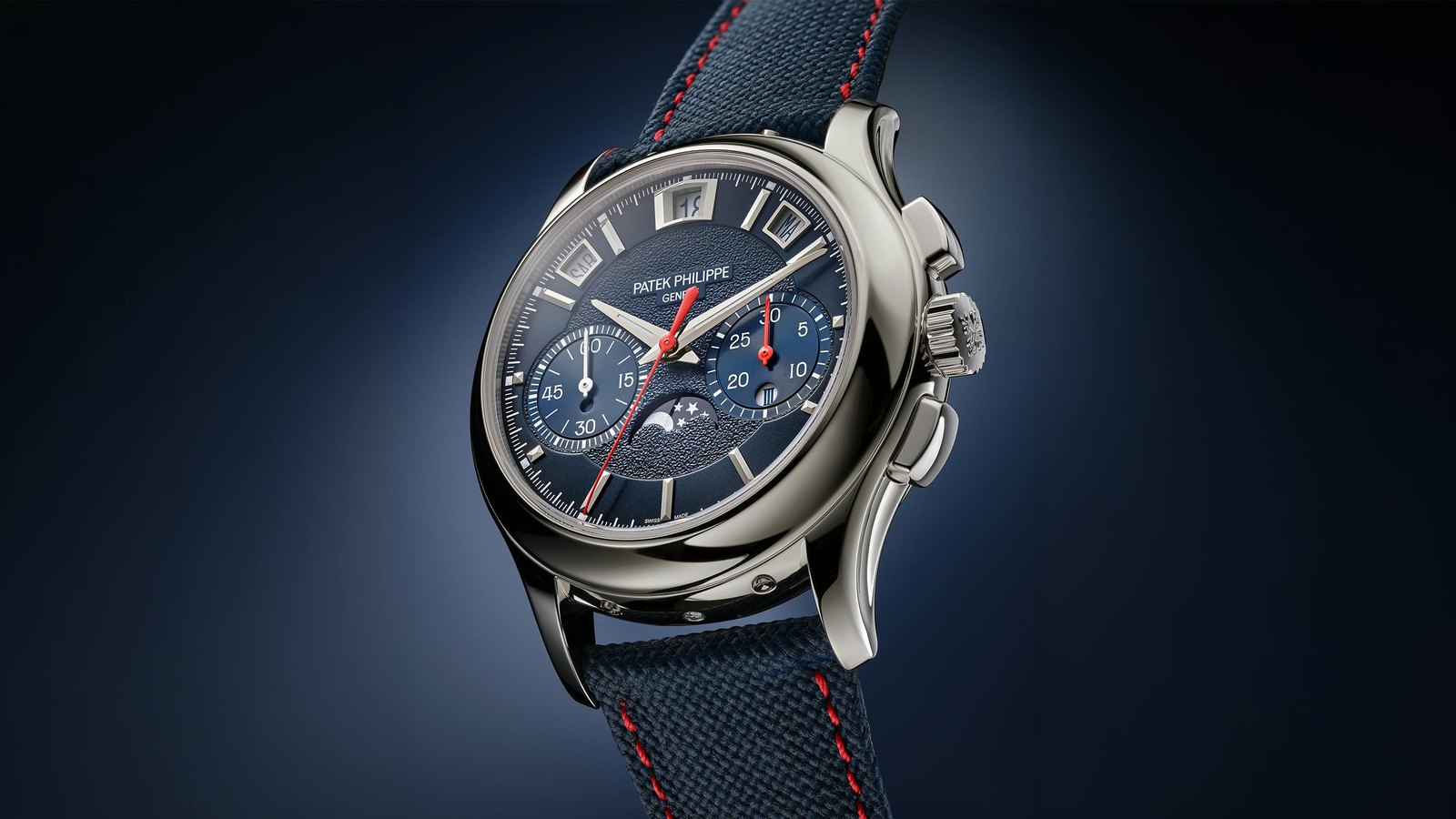
Patek Philippe 5978P
Some families grow slowly on purpose. Patek Philippe has been making perpetual calendar chronographs since 1941, and in all that time it has given us only six references: the 1518, the 2499, the 3970, the 5020, the 5970 and the 5270. Each one stayed long enough to become the yardstick for everybody else. So when a seventh shows up, the whole industry pays attention.
The 5978P arrived in Milan for the brand’s Watch Art Grand Exhibition, the seventh of those free public shows and the largest yet, which ran from October 2 to 18. What makes it new is the calendar. Instead of the usual subdials, the day, date and month sit in windows along an arch at the top of the dial, a layout borrowed from the 5208 and 5308 grand complications, and all three change at once, in about 30 milliseconds, at midnight. It’s the first hand-wound perpetual chronograph from Patek with an instantaneous calendar, built on the CH 29-535 chronograph base and housed in a 42mm platinum case.
It’s limited to 120 pieces for the Italian market and costs about $338,000, roughly $90,000 more than the 5270P that sits in the catalog. For the first time since the early 1990s, Patek has two perpetual chronographs in its line-up at once, which tells you how confident it is that collectors want a choice between the old way and the new one.
Limited editions have a habit of becoming previews. If this one does, the eighth reference will have a very hard act to follow.
Patek Philippe Gondolo Ladies First
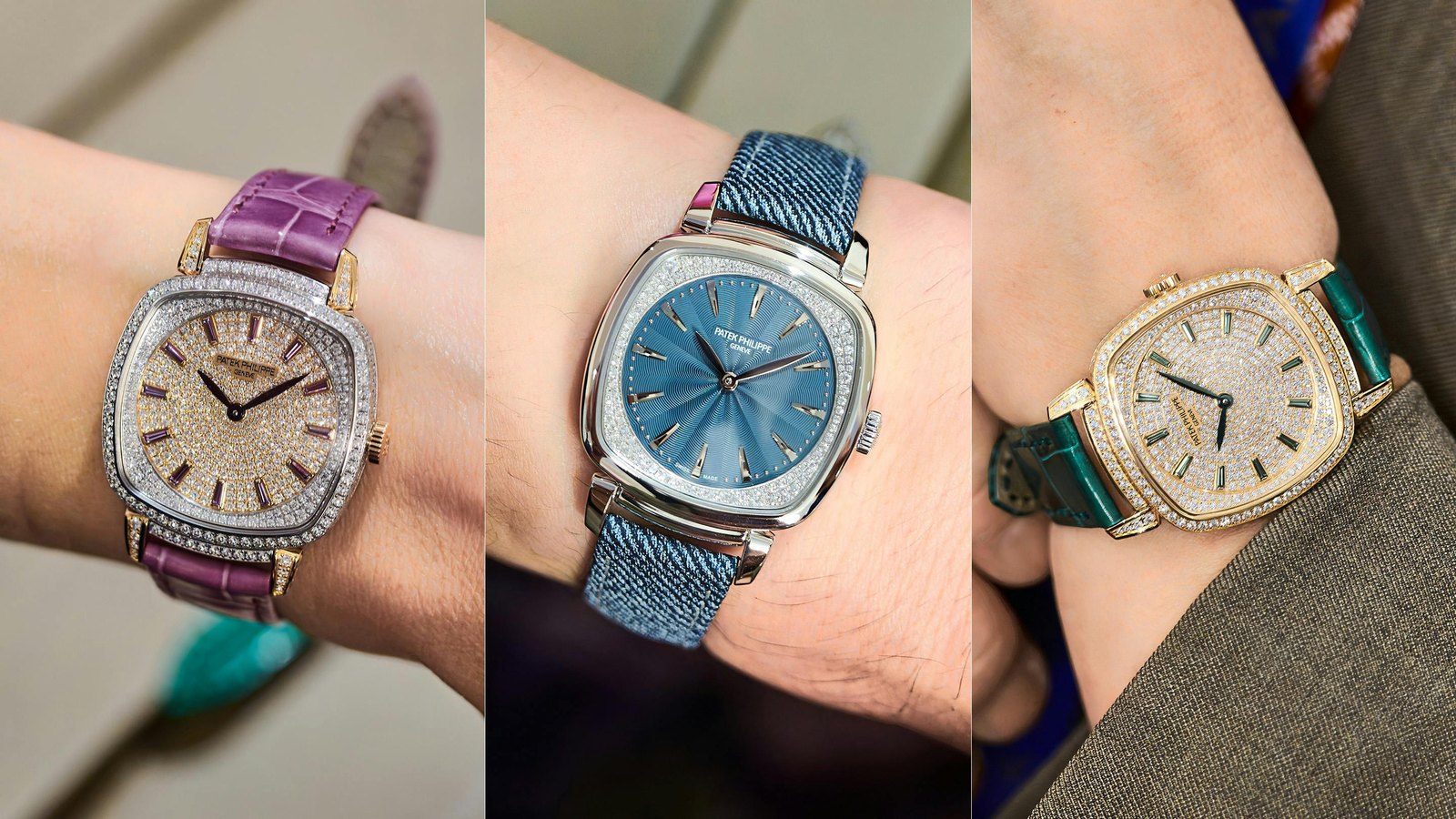
Patek Philippe likes to remind people that its first wristwatch was made for a woman, Countess Koscowicz, in 1868, long before men decided wristwatches were serious. It’s a good story, and the brand has used it carefully, most memorably in 2009 with the Ladies First Chronograph, the first watch to carry its in-house CH 29-535 movement. Milan brought the name back in a softer shape.
The new Gondolo Ladies First, reference 7043, comes in six versions, all in a 31mm by 34.8mm cushion case. Three have diamond-set dials and three are fully set Joaillerie pieces, in rose gold, white gold or both, with colourful straps and gemstone hour markers that are a long way from the restraint of the chronograph that inspired them. Inside is the E15 quartz movement, just 1.8mm thick, with a battery that lasts about three years. The Gondolo collection itself dates to 1993, a tribute to the Brazilian retailer Gondolo & Labouriau, once one of the brand’s biggest clients.
Prices start at $37,510 and run to $68,768 for the fully gem-set models. The more restrained models keep the diamonds around the dial, while the 7043/250 references go all in, and a couple of the strap choices, denim pattern included, lean deliberately casual.
Quartz in a Patek will always start an argument among collectors. The brand seems content to let it, and to keep making watches for the people who simply want to wear something beautiful every day.
A. Lange & Söhne Datograph Perpetual
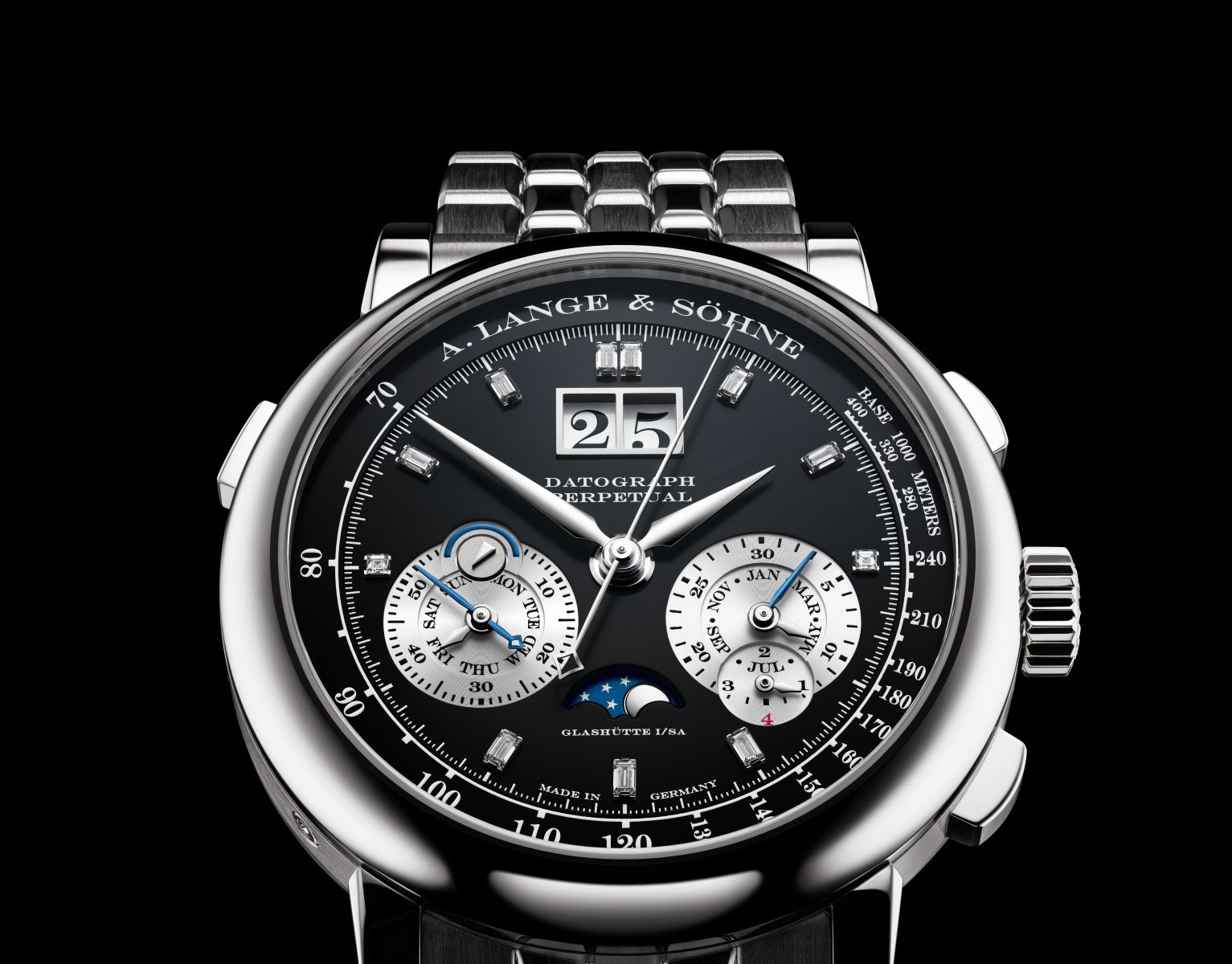
A. Lange & Söhne has always dressed its watches like a Saxon banker: dark suit, leather strap, nothing on show. Odysseus aside, the brand hasn’t offered a regular watch on a bracelet since the days when the German jeweller Wellendorf made them. That changed this month, and it changed in platinum.
The new Datograph Perpetual, reference 410.136E, puts the brand’s flagship chronograph with perpetual calendar on a five-row platinum bracelet. The case is 41mm by 13.5mm, also in platinum, and the dial is black, the first time a standard Datograph Perpetual has come in black rather than grey or silver. In place of the usual baton markers there are baguette-cut diamonds, about 0.13 carats in all, with shorter stones at 3 and 9 o’clock so they don’t crowd the subdials. The layout is the familiar one, with the outsize date at 12 o’clock, and the hand-wound L952.1 movement carries on unchanged underneath.
It’s limited to 50 numbered pieces. Lange doesn’t publish a price, but it’s reported at about $313,000, and the brand’s best clients will have heard about it long before anyone else.
None of this is a technical leap. It’s a change of manners, and for a brand that has spent three decades being proudly formal, that might matter more. Twenty years after the first Datograph Perpetual, Lange has decided its most serious watch is allowed to relax a little, and to shine while it does.
Omega Seamaster Diver 300M James Bond and Spectre Editions
Omega has been putting watches on James Bond’s wrist since 1995, long enough that the partnership now has its own traditions. This year the brand teased its newest pair with Easter eggs on its website and a product listing whose description was a long string of binary code, which is more effort than most villains put into their plans.
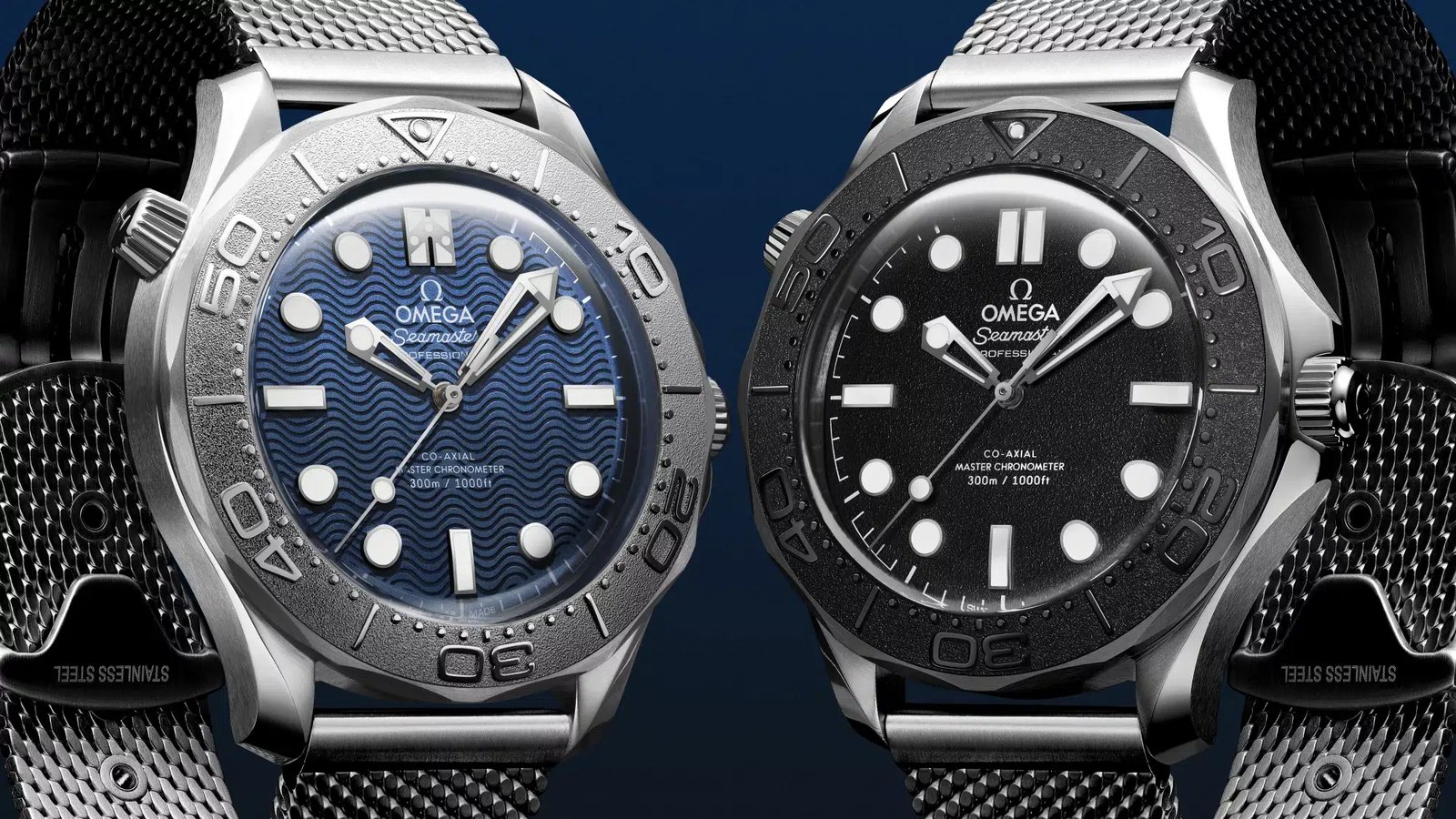
The result is two Seamaster Diver 300M models that play hero and villain. The James Bond Edition has a dark blue wave-pattern dial, a titanium bezel insert in relief and the Bond family crest as its 12 o’clock marker. On the back, an oversized rotor is styled after the famous gun-barrel opening of the films. The Spectre Edition goes the other way: a stippled black dial, a black ceramic bezel in relief, and the octopus logo on the rotor. Both use a 42mm case, 14.23mm thick, with the Master Chronometer calibre 8806 inside and a Milanese mesh bracelet outside.
Each costs $8,600. Alongside them come two limited sets of 77 pieces each, a white gold Bond and a platinum Spectre, at $89,800 apiece.
It isn’t a new Seamaster, and it was never meant to be. Bond watches are about the story you tell when someone notices your wrist, and Omega has given its customers two good ones to choose from.
Jaeger-LeCoultre 101 Chain
In 1929 Jaeger-LeCoultre introduced the Calibre 101, a hand-wound movement 14mm long, 4.8mm wide and 3.4mm thick that weighs about a gram. Nearly a century later it’s still the world’s smallest manually wound mechanical movement, built on the same two-level Duoplan architecture the brand patented in 1925, and each one takes about 40 hours to assemble by hand. The brand only makes a few dozen watches with it a year, and every one is a piece of jewellery first.
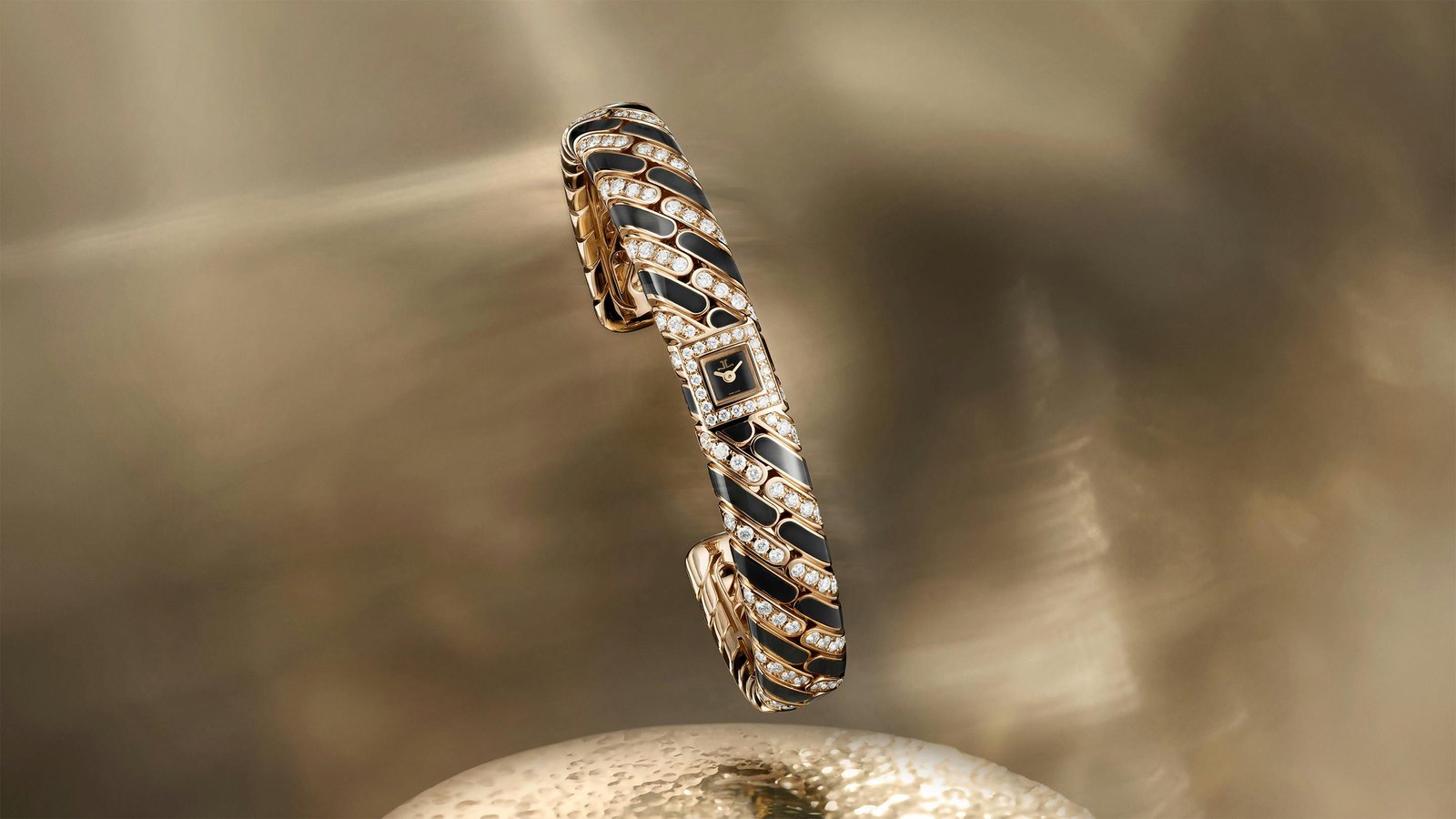
The new 101 Chain takes its cue from a 1955 Duoplan nicknamed the Chain for its braided gold bracelet. This version is a sculptural 18-carat pink gold bangle with diagonal bands that alternate between black HyCeram, a high-gloss ceramic, and diamonds. The mould for the bangle has 36 cavities, each filled by hand. The tiny dial sits inside a diamond bezel, bringing the total to about 2.73 carats.
Jaeger-LeCoultre gives the price on request, as it does for most of its high jewellery, and the reference to ask for is Q2842270.
Small jewellery watches have been having a moment, and plenty of them get there with quartz. What makes this one different is that the diamonds are the supporting act. The star is a movement that was already a marvel when your great-grandparents were young, and still is.
MB&F LM1 EVO
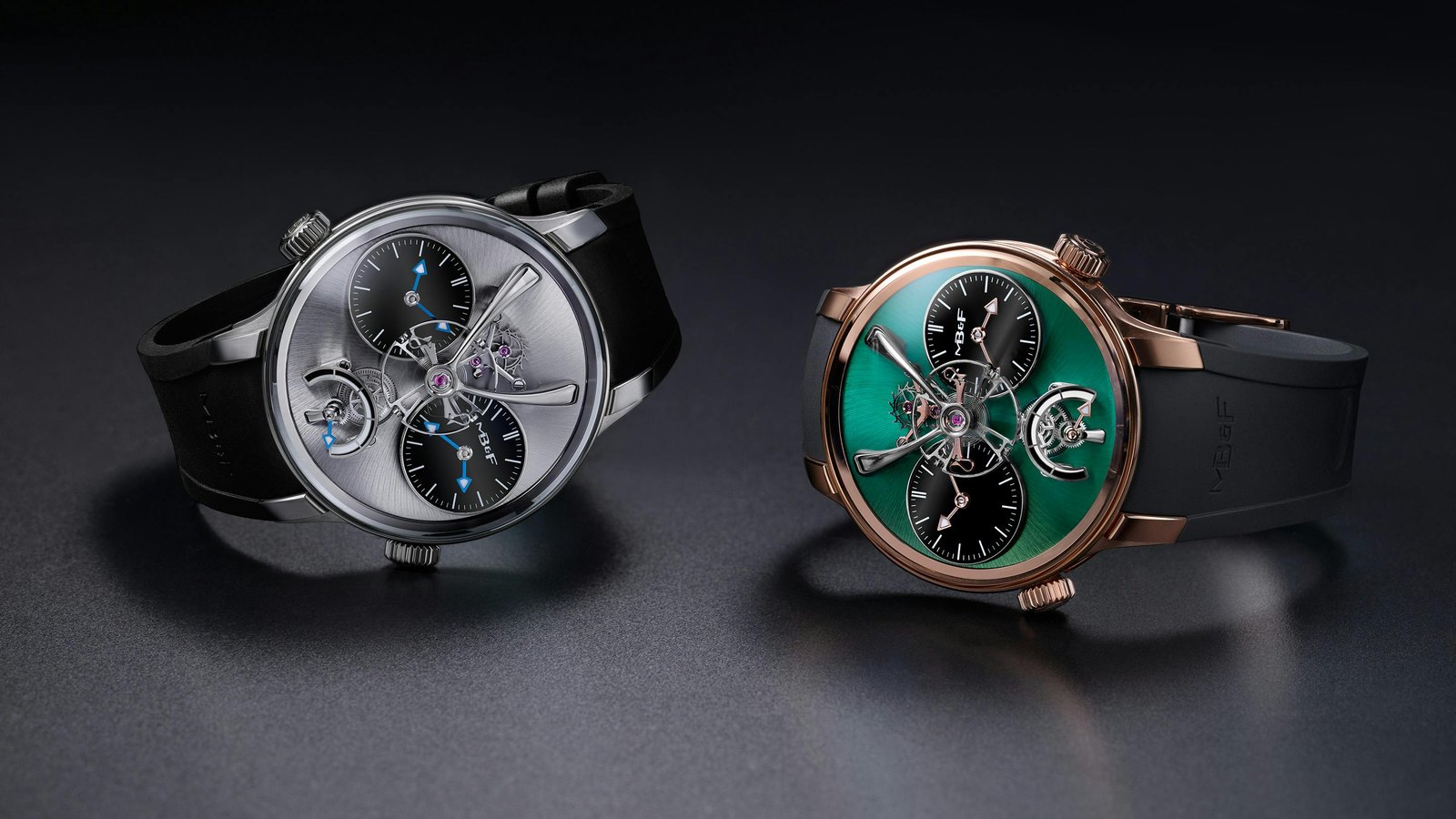
When MB&F launched the Legacy Machine No.1 in 2011, it was the brand’s idea of a classical watch: a round case, two dials and a balance wheel floating above everything like a chandelier. It won two prizes at the Grand Prix d’Horlogerie de Genève in 2012, including the public vote, and it was also delicate. The EVO line, now six years old, was the fix, with a sportier case, more water resistance, the FlexRing shock protection system and rubber straps. This is the sixth EVO, and the first to bring back the original.
The LM1 EVO comes in titanium or a limited rose gold, both 42mm by 16.8mm and 52mm lug to lug, with two dials showing two independent time zones. The power reserve indicator now rotates, and the case has been reworked to take quick-change rubber straps. Underneath, the hand-wound movement designed by Jean-François Mojon, with finishing by Kari Voutilainen, gains a Straumann double hairspring. It runs at 18,000 vibrations per hour with 60 hours of reserve.
The titanium version is $109,000. The rose gold, with a green dial plate, is limited to 33 pieces at $137,000.
For years, choosing a Legacy Machine meant choosing between the pretty one you admired and the practical one you could actually wear every day. MB&F seems to have noticed that most people would rather not choose.
Urwerk UR-300 Time Quantum
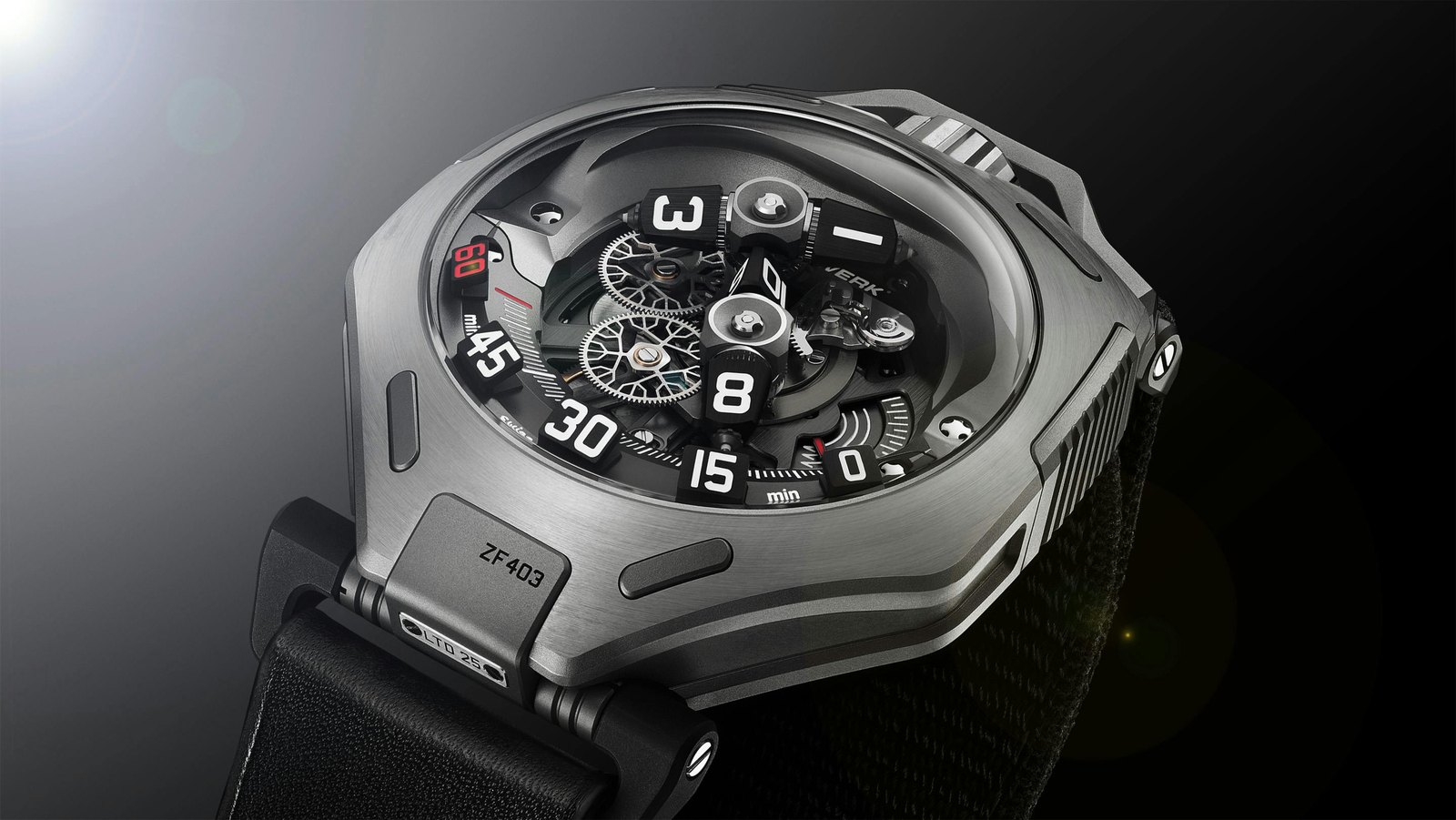
Felix Baumgartner and Martin Frei have spent three decades at Urwerk telling the time with satellites, an idea they trace back to a 17th-century night clock made for a pope: rotating hour modules that travel around a minute track and snap to the next hour when the time comes. Every new Urwerk is really an argument about how that snap should happen. The UR-300 Time Quantum makes the most dramatic case yet.
Instead of a single carousel, the display uses a T-shaped frame. The current hour points to the minutes as it travels along a 108-degree arc. When the hour ends, the whole frame jumps 72 degrees in one go and the hour modules rotate 120 degrees, so the next number snaps into position to start its own journey. That kind of sudden movement takes energy, and the calibre UR-30.01V is wound by Urwerk’s Dual Flow Turbine system, beating at 4Hz with 44 hours of reserve.
The titanium case is 45.2mm by 58.8mm and 18.25mm thick, which is large even by Urwerk standards. There are two versions, plain titanium and titanium with a dark AlTiN coating, each limited to 25 pieces at about $204,000.
Most watches try to make the passing of an hour graceful and quiet. Urwerk would rather you saw it arrive, all at once, every single time.
Biver AB
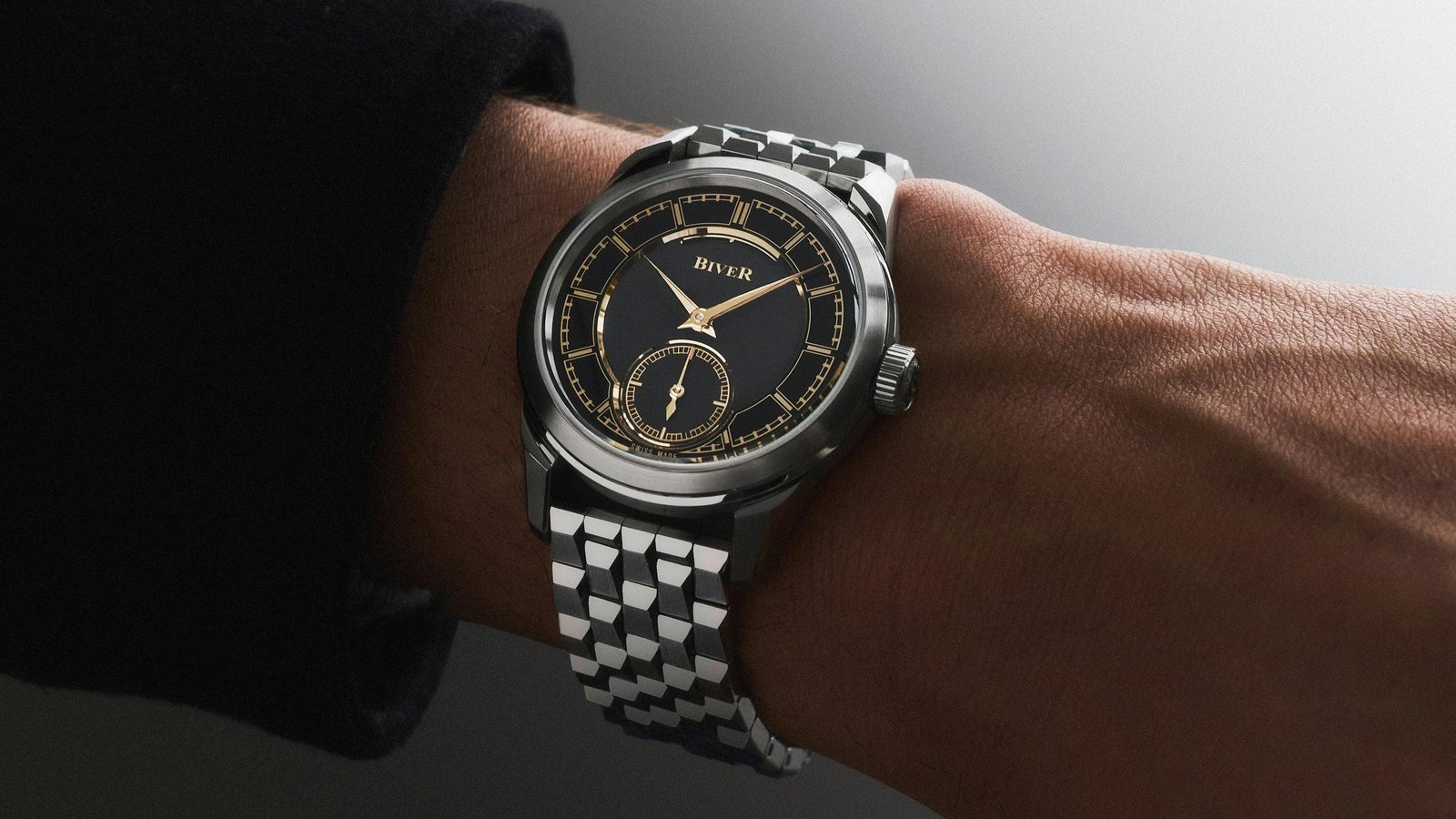
When a brand has a hit, the easy move is to make it again in a cheaper metal. Biver, the company Jean-Claude Biver founded with his son Pierre, had exactly that hit with the Automatique, a gold watch with a micro-rotor. When it finally decided to work in steel, it didn’t simply swap the metal. It started again from scratch.
The AB is Biver’s first stainless steel watch, and it has a new movement to go with it. The case is 38mm by 9.8mm with a 19mm lug width and 80 metres of water resistance, for people who want to wear an expensive watch without babying it. The dial is framed by an onyx ring, a material the brand has made a signature. Inside, the hand-wound calibre JCB-004, made in gold and developed with Le Cercle des Horlogers, has two barrels in series and is expected to run for about 120 hours. An aperture on the dial shows how much is left, and a zero-reset sets the seconds hand back when you pull the crown.
It costs about $82,000, around $20,000 less than the entry point to the Automatique, and comes on a steel bracelet with micro-adjustment.
Giving customers what they ask for is good business. Giving them something better than they asked for is how brands earn a second decade.
Breitling Navitimer B09 and B02 Cosmonaute 41
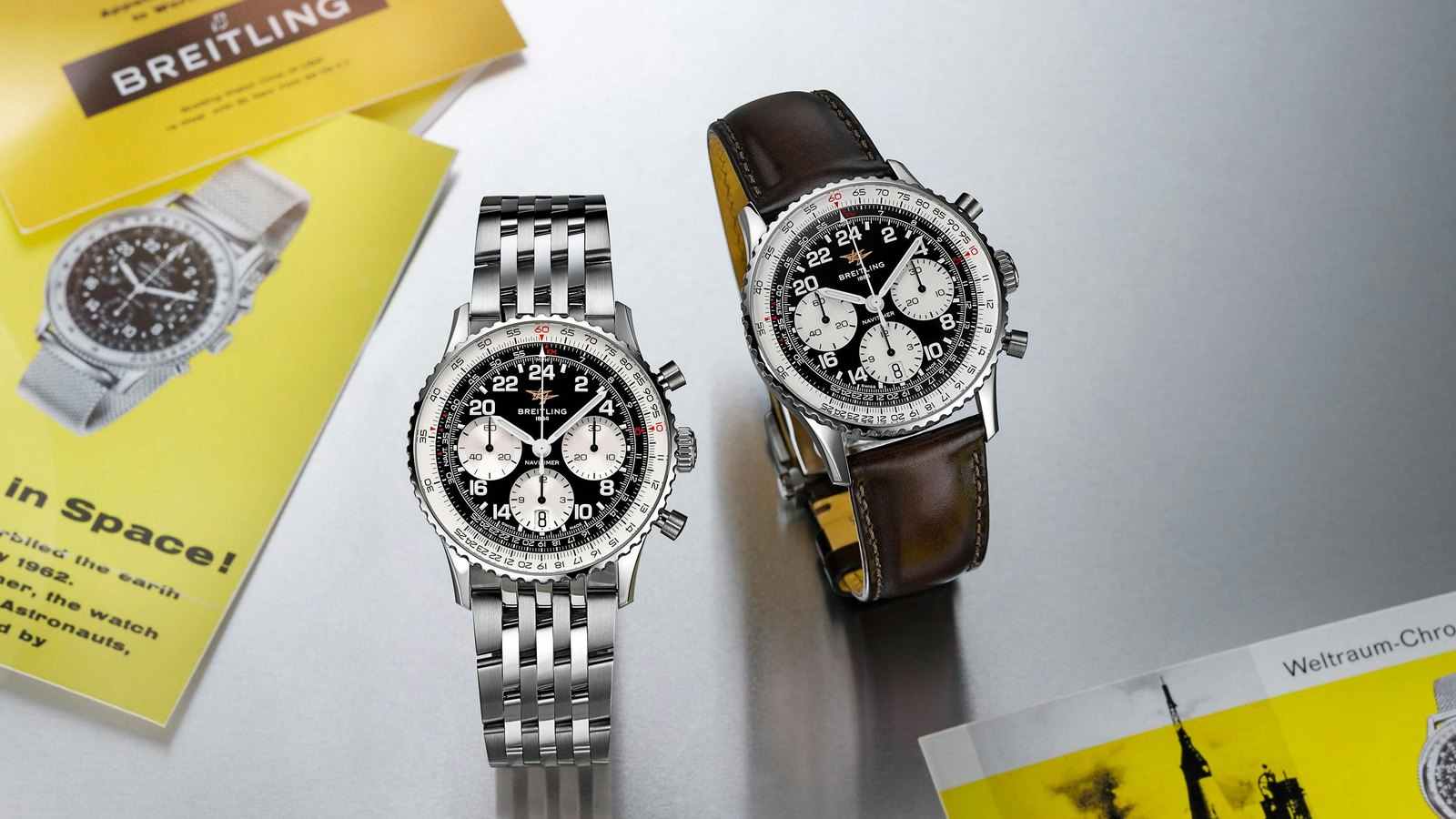
In 1952 Breitling gave pilots the Navitimer, a chronograph with a slide rule for working out fuel and speed in the cockpit. Ten years later it went further. On May 24, 1962, Scott Carpenter wore a 24-hour version into orbit aboard Mercury-Atlas 7, and the Cosmonaute became, by Breitling’s account, the first Swiss wristwatch in space. For years after that, the hand-wound versions closest to those originals came mostly as limited editions.
Now both join the main collection at 41mm. The Navitimer B09 Chronograph 41 takes its cue from the 1960s Navitimers worn by racing drivers such as Jim Clark and Graham Hill, with a reverse-panda dial and no date window. The Navitimer B02 Chronograph 41 Cosmonaute keeps the 24-hour display Carpenter needed when day and night came roughly every ninety minutes. Both have steel cases 13mm thick and 47mm lug to lug, 30 metres of water resistance, the Twin Jet logo first used in 1957, and hand-wound, COSC-certified movements beating at 28,800 vibrations per hour with about 70 hours of reserve. It’s the first time the B09 has appeared outside limited editions.
The B09 is $7,900 on a strap and $8,400 on a bracelet. The Cosmonaute is $10,600 on a strap and $11,000 on a bracelet.
Breitling has spent a few years reminding people where it comes from. Putting its most authentic Navitimers in the regular catalog is the clearest way yet to say it means it.
Hublot Classic Fusion Tributo
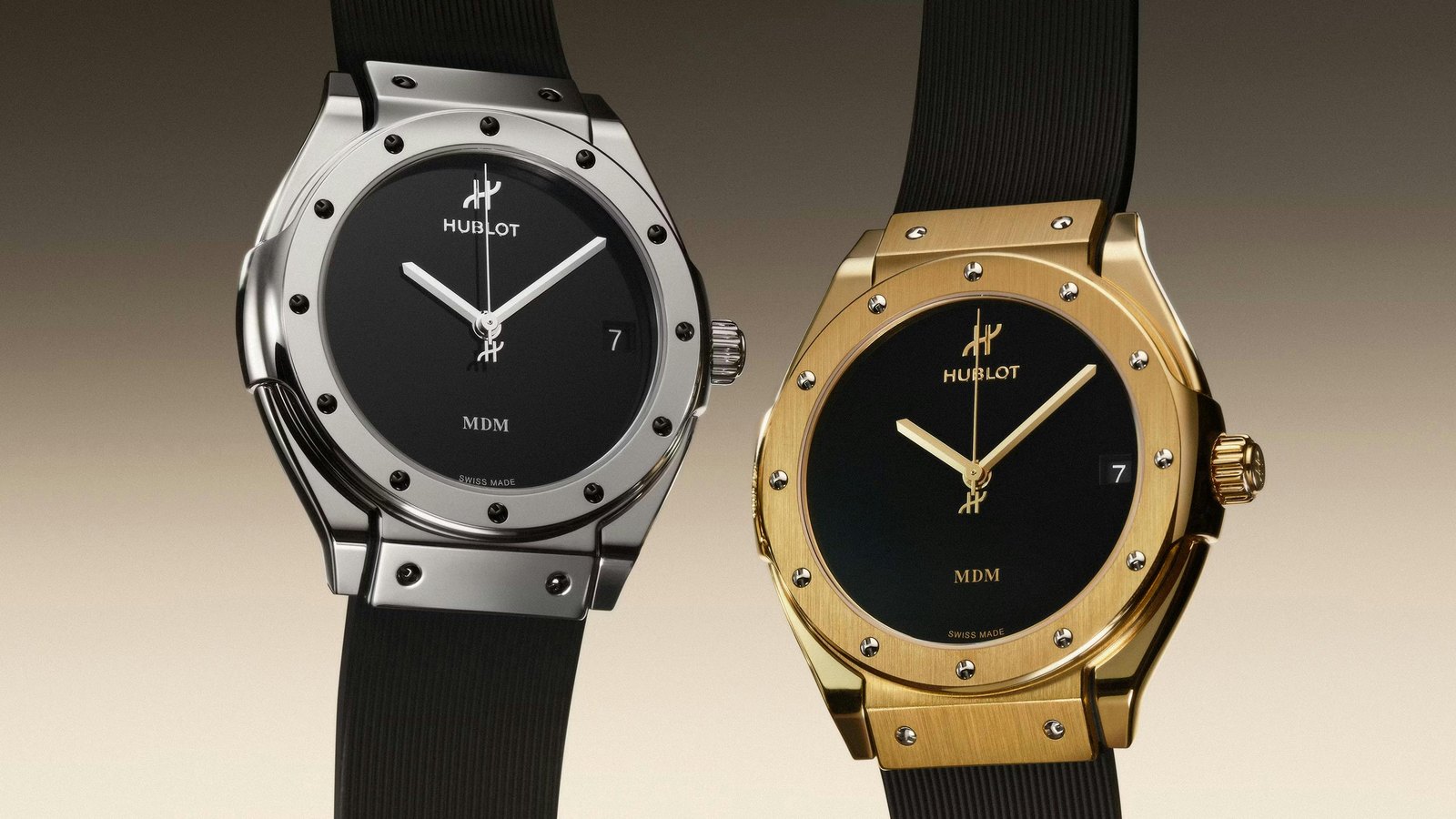
In 1980 a gold watch on a rubber strap was close to scandalous. Carlo Crocco did it anyway, creating the MDM, the first Hublot, a gold watch with a porthole bezel on a natural rubber strap. Europe’s wealthy took to it, and an entire category of casual luxury followed. Crocco left the brand in 2008, but forty-six years on, Hublot asked him back to help.
The Classic Fusion Tributo isn’t the first tribute the brand has paid to its first watch, but it’s the closest. It returns to the original’s 12-screw porthole bezel and black dial on an integrated black rubber strap, in a 38mm case of yellow gold or white gold. It’s 9.5mm thick against the first watch’s 6.5mm, but that original was quartz, and this one has a mechanical movement sourced from sister brand Zenith. Crocco focused on two details, the twelve screws and the black rubber, and they’re exactly what make it read as the original at a glance. Water resistance is 100 metres.
Each costs $30,900, and Hublot will donate about $121,000 from sales of the Tributo to the Main Dans la Main Foundation, which Crocco founded in 1998 to support vulnerable children and communities.
Hublot is a brand that has spent decades getting louder. It turns out the most refreshing thing it could do was whisper its own name, the way it did the first time.
Habring² x SJX Watches Chrono Felix Perpetual “Star”
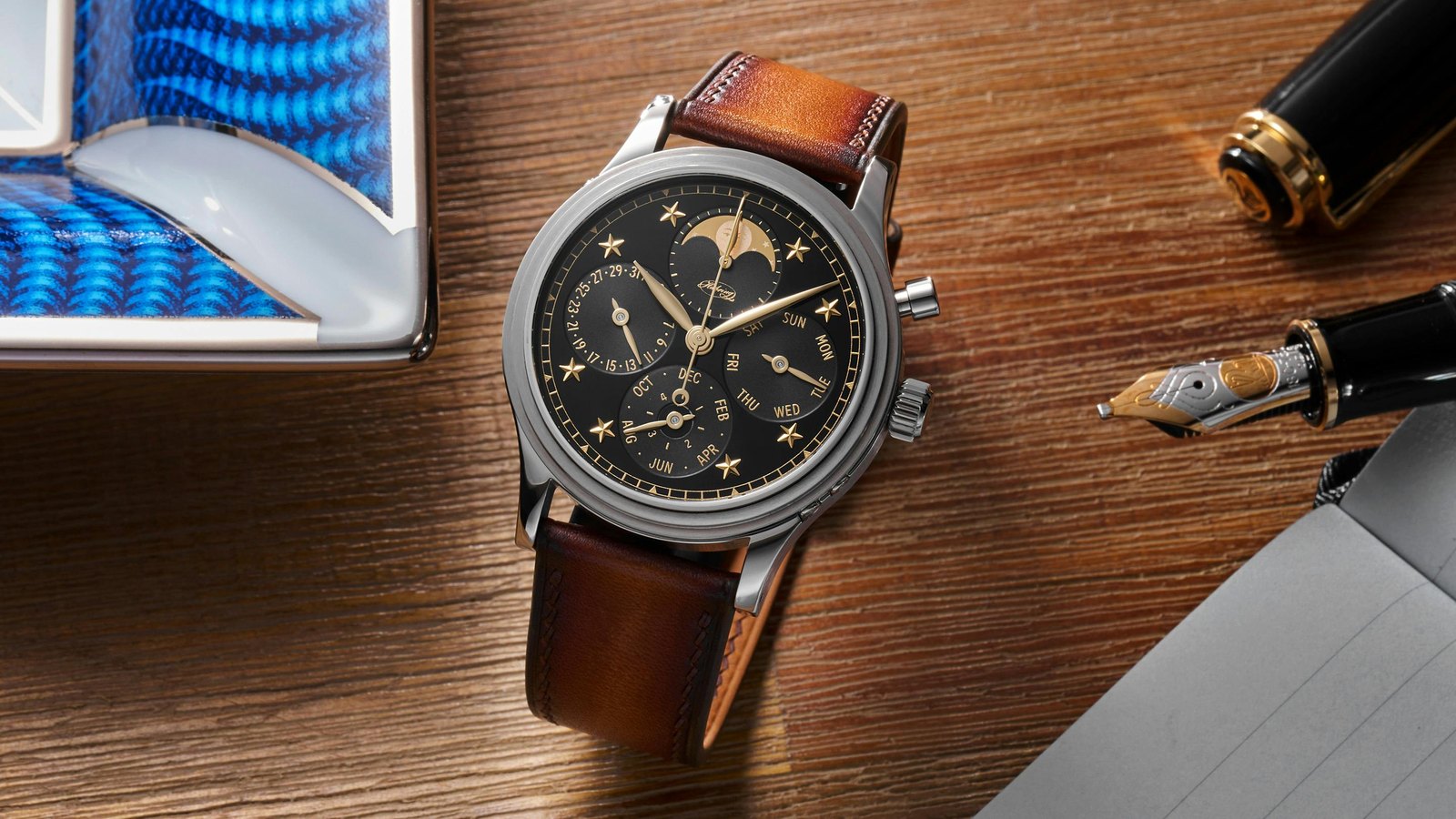
There are a few small Austrian workshops that independent collectors talk about in the same breath as the big names, and Habring², run by Richard and Maria Habring in Völkermarkt, is one of them. Richard spent years developing chronographs for bigger brands before going his own way. Its partnership with SJX Watches has become a habit. The first collaboration, the Erwin “Star”, put gold stars on a dial. The second, the Chrono-Felix Medicus, was a hit in two versions. This third one goes back to the stars with a far more complicated watch underneath.
The Chrono Felix Perpetual “Star” combines Habring²’s A11 monopusher chronograph base with a Dubois-Depraz perpetual calendar module. The dial is glossy black lacquer with matte black snailed subdials, eight applied gold-plated stars as hour markers and matching hands, a nod to the vintage “galaxy” dials collectors chase on Rolex Stelline watches. The steel case is 38.5mm by 13mm. The hand-wound movement beats at 4Hz with 48 hours of reserve, and the chronograph levers were finished by hand in Germany by independent watchmakers Pöhlmann-Bresan.
It’s limited to 30 numbered pieces at $28,500, and buyers put down 40 percent to reserve one.
Perpetual calendar chronographs usually come from the very top of the industry, with prices to match. This one costs a fraction of that, comes from a small family workshop, and still has a hand-finished story behind it.
Seiko Power Design Project Panda Chronographs
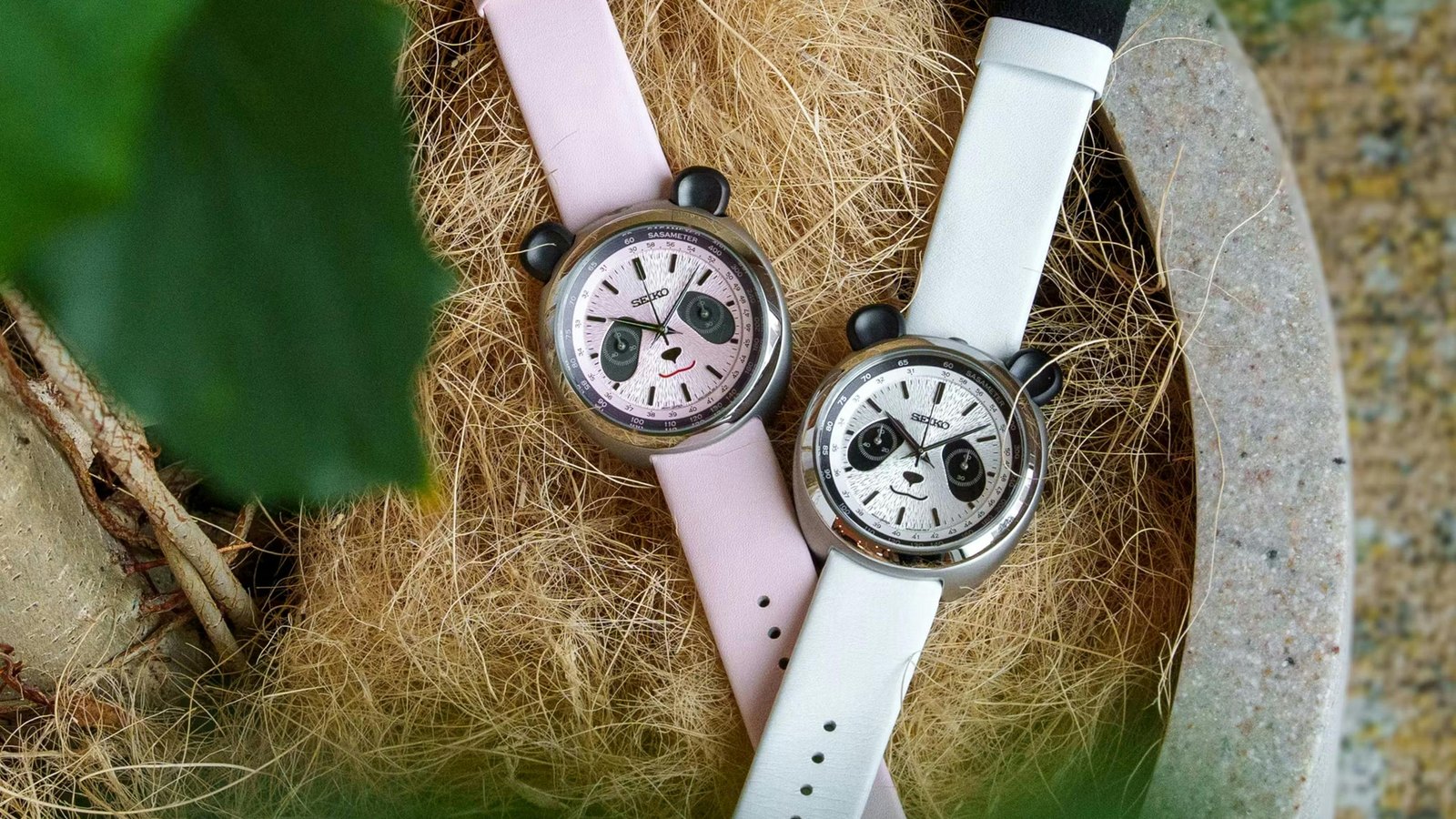
Every so often Seiko lets its designers off the leash. The Seiko power design project is an internal programme that encourages them to explore ideas without worrying about whether anyone will buy them, and in 2024 it produced the Incredibly Specialized Watch Exhibition, concept watches for absurdly specific audiences. The crowd favourite was called A Watch Exclusively for Panda Lovers. Two years later, it’s real.
Designer Kiyotaka Sakai, who also works on Grand Seiko’s Evolution 9 collection, started with a simple question: collectors have called black-and-white chronographs panda dials for decades, but does anyone actually see a panda? His answer draws on the Japanese idea of mitate, finding unexpected likenesses between unrelated things. The subdials became drooping eyes, the pushers became ears, and the hands became bamboo leaves. It’s the only chronograph we know of that looks pleased to see you.
The production models, references HHK001 and HHK002, stay remarkably close to the concept: a 43mm steel case, the 8T61 quartz chronograph movement and a choice of the original black and white or a pink and grey version inspired by the skin of a newborn panda. They go on sale in November, limited to 3,000 and 2,000 pieces respectively, at $540 each.
The watch industry spends a lot of energy convincing people it’s serious. Sometimes the best thing it can do is remember that watches are supposed to make you smile.
Auctions & records
A Voutilainen online and three Journes in a room
New York had two very different auctions in October, and between them they said a lot about where the market is, and where it’s heading. The first never happened in a room at all. Phillips’ online New York Sessions sale ran from October 1 to 9, sold all 88 lots for $5,712,841 in total, and saw a steel Voutilainen 28Sport, number 5 of 8, climb from an estimate of $120,000 to $240,000 to $1,016,000.
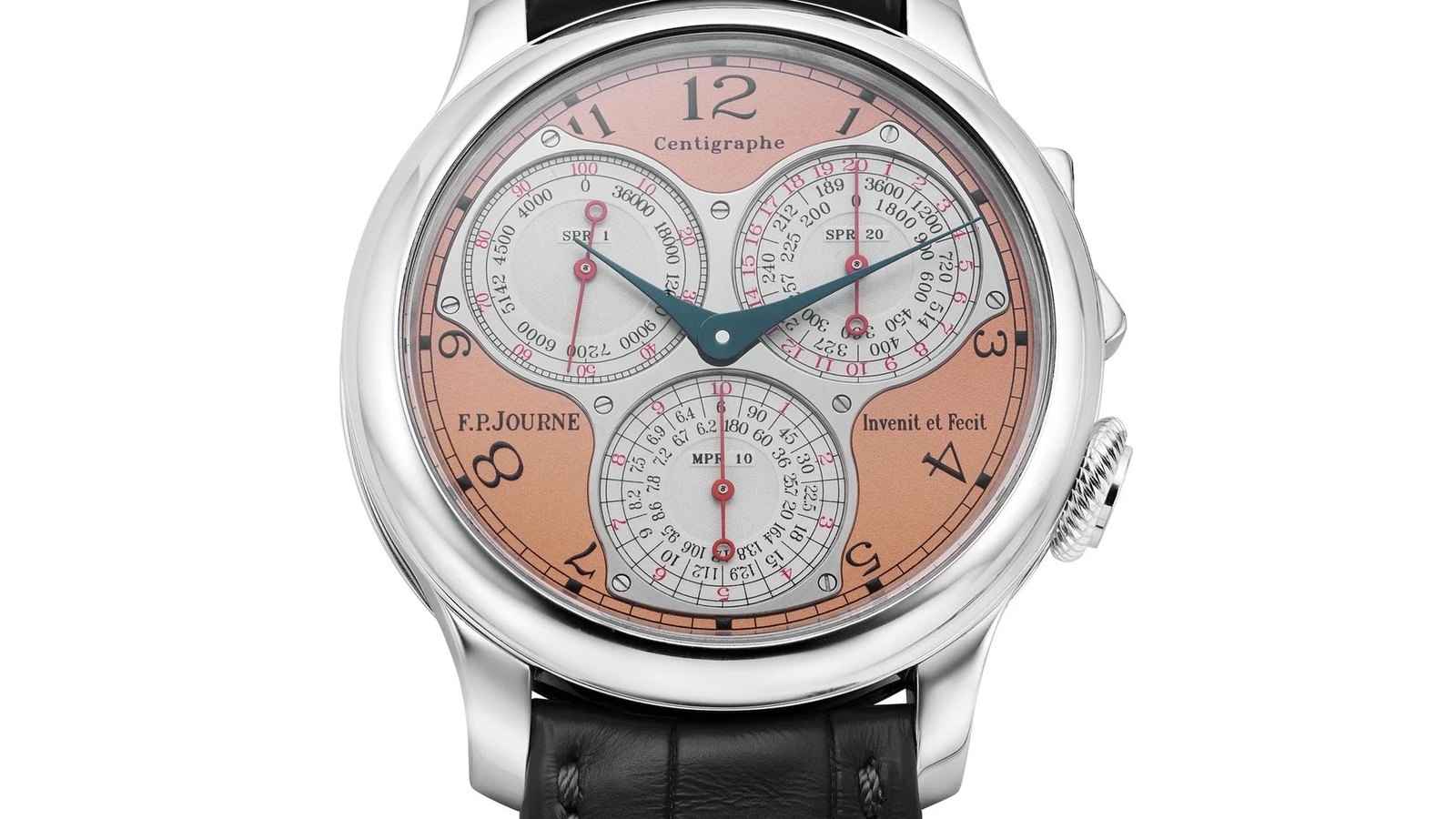
Nine days later Antiquorum returned to New York with a live sale on October 18, and F.P. Journe took the evening. Three Journe watches passed a million dollars: a 2011 platinum Centigraphe Souverain with a salmon dial at $1,670,000, against an estimate of $600,000 to $1,000,000; a Tourbillon Vertical from the Black Series at $1,550,000; and a Vagabondage II at $1,310,000. Nine Journe lots made $6,617,500 of a $14,580,812 total, which means one watchmaker accounted for nearly half of the sale.
Plenty of people in the trade say independent prices have to be near their peak. They’ve been saying it for a while.
What October showed is that the buyers for these watches no longer need a saleroom, a catalogue or even each other. They need a screen, a reason and a watchmaker whose name means something. Voutilainen and Journe both qualify, and the bidding treats them that way.
Marteau & Co. sells every lot of The Encore
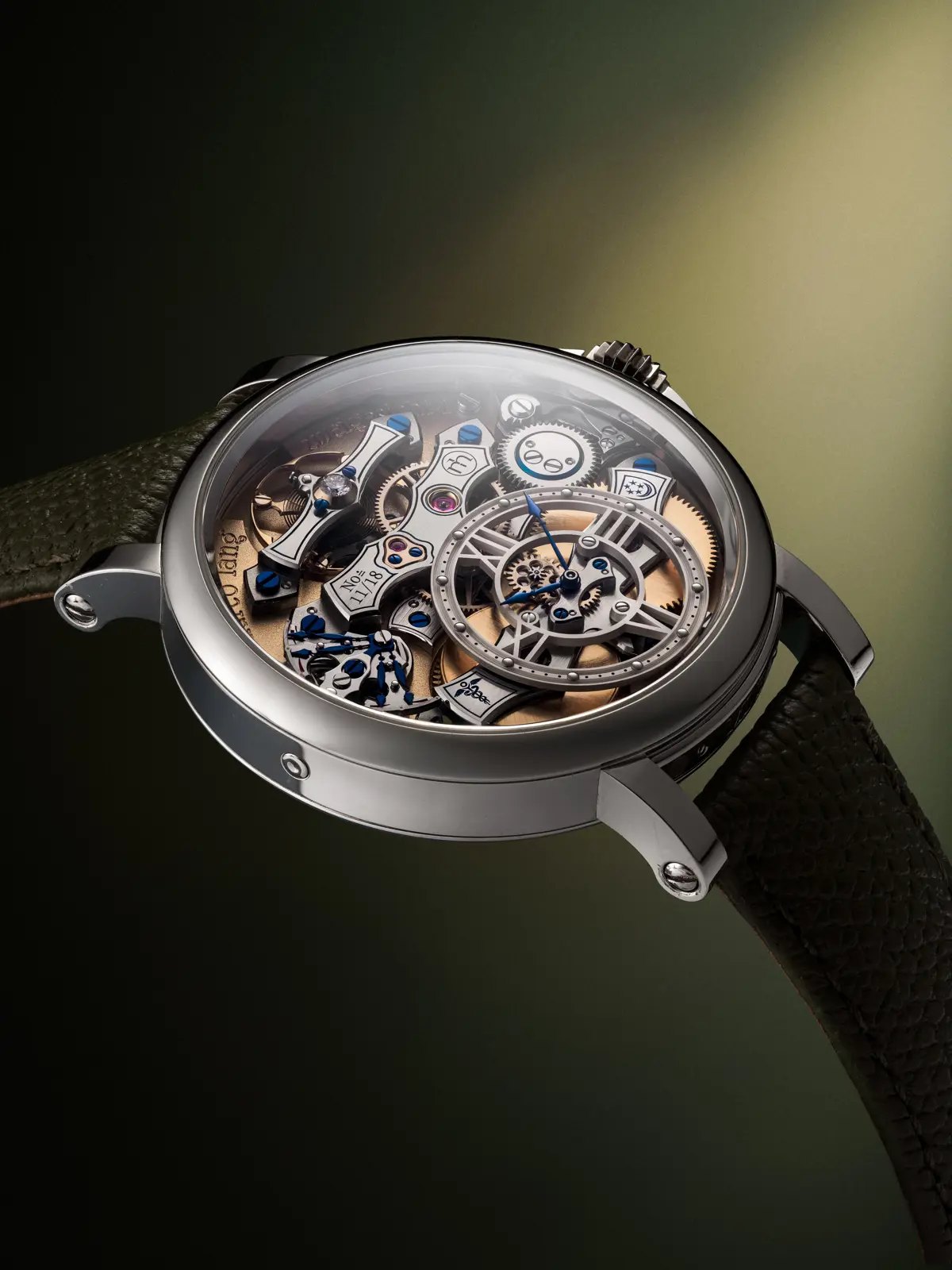
Marteau & Co. is a young auction house that has built its name on independent watchmaking, and its sales have quickly become a barometer for that corner of the market. Its latest online sale, The Encore, ran from October 8 to 15, and every one of its 42 lots found a buyer, the kind of result the trade calls a white glove sale.
The total was about $9.8 million, which the house says is the highest result for an online watch auction this year. It also set world auction records for three makers. A Marco Lang Zweigesicht-1, the first ever offered at auction, sold for about $800,000, a unique rose gold Origine by Sylvain Pinaud for about $640,000, and a unique piece by the Japanese-born, Swiss-based Yosuke Sekiguchi for about $582,000. Taken together, the sale made 131 percent of its high estimates.
A few years ago, names like Pinaud and Sekiguchi were known to a few hundred collectors who’d visited workshops or met the makers at small fairs. Now their watches are setting records, and the sale as a whole beat its estimates by a wide margin. Part of that is scarcity. These makers produce a handful of pieces a year, and there’s no catalogue to order from.
Part of it is that collectors have started to treat independent watchmaking like art, buying the hand as much as the object. Whether the prices hold is anyone’s guess. The craftsmanship will, and that’s what people say they’re paying for.
Events
New York Watch Week
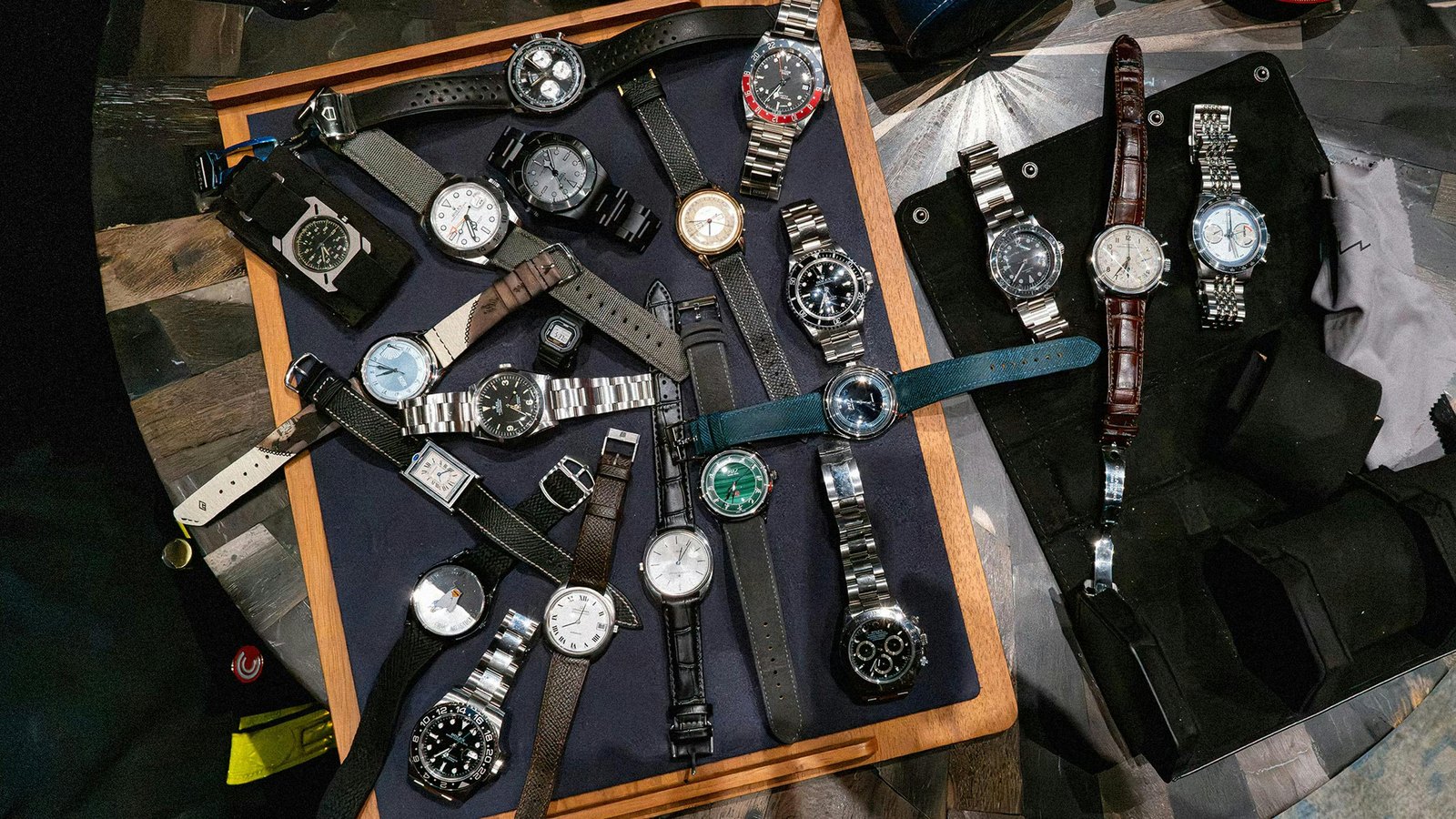
For one week in October, New York becomes one of the busiest watch cities in the world, and this year it ran from October 15 to 18. It started with the FHH New York Watch Summit on Thursday, a day of talks on the business of watches, and then split into two very different shows that ran side by side all weekend.
At Gotham Hall, the high-end fair hosted 48 brands, with first-time appearances from Ferdinand Berthoud, Kudoke, Kollokium and the revived Daniel Roth among others. A short walk away, the Windup Watch Fair filled Center415 on Fifth Avenue with more than 160 names, many of them microbrands, plus straps, tools and makers happy to talk for as long as you’ll listen. Entry was free.
The two shows tell you a lot about the American market. One is about craftsmanship and serious money, the other about discovery and community, and the same people often visit both on the same afternoon. Brands that once treated the US as a place to ship boxes now treat New York as a stage, timing launches and events around this week.
There’s a lesson in that. Watches are sold one wrist at a time, and the most valuable thing a fair can offer is still the chance to try one on and talk to the person who made it.
Vacheron Constantin and Phillips name 34 Concours finalists
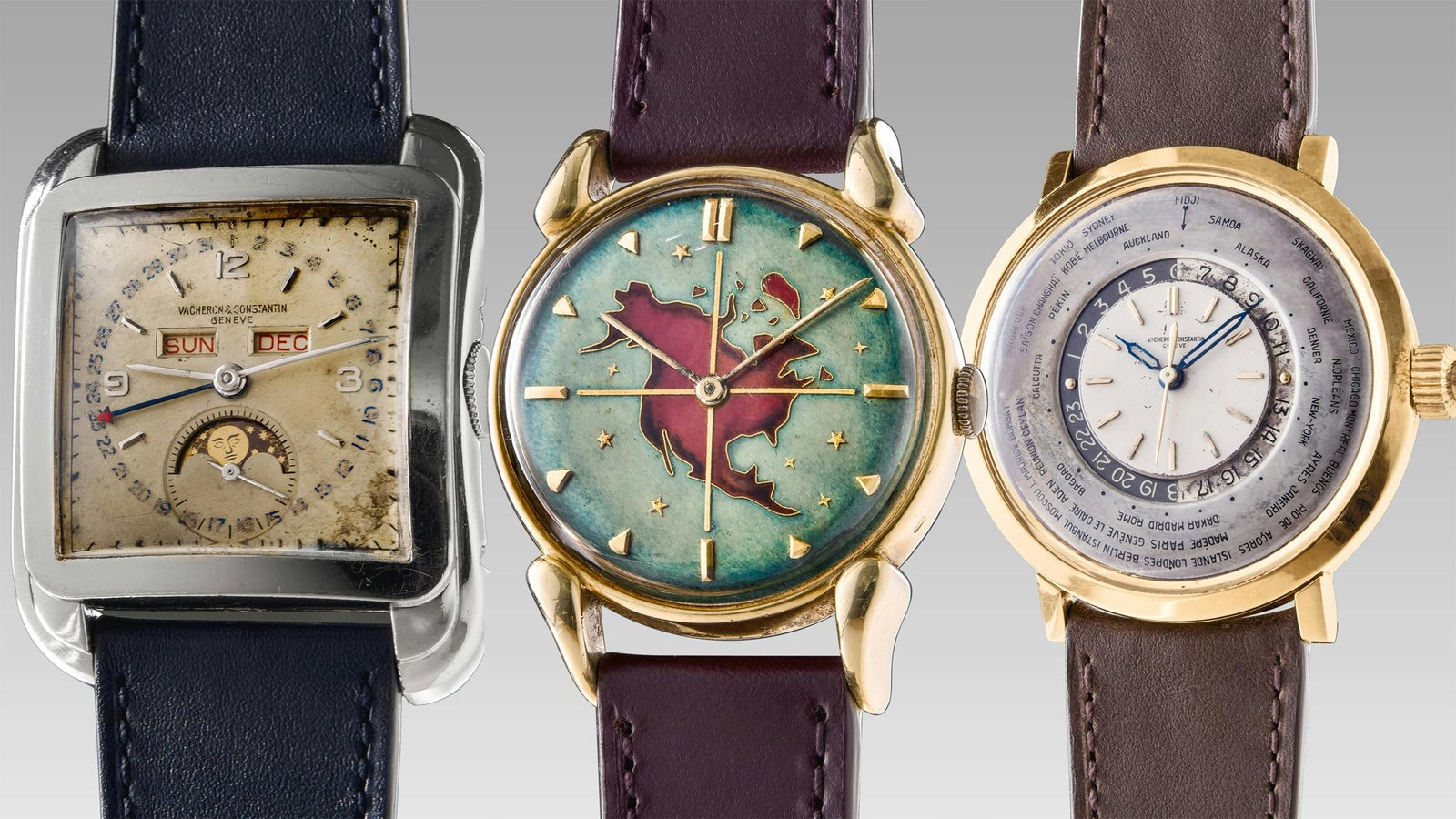
Car people have had concours d’élégance for a century, lawns full of perfectly kept automobiles judged on beauty, originality and history. Earlier this year Vacheron Constantin and Phillips decided vintage watches deserved the same, and opened a call to collectors around the world. A fourteen-member jury went through 550 entries, and in October it named 34 finalists.
They compete in seven categories: chronographs, Métiers d’Art, Chronomètre Royal, astronomical complications, multiple complications, design and chiming watches. Every finalist was inspected by Vacheron’s heritage department for authenticity and documentation. Among them are two references 4764 “Cioccolatone” triple calendars, one in rose gold and one in platinum that last sold at auction in 2022 for more than $700,000, a reference 6213 world time, a reference 6448 minute repeater with diamond markers and the famous Don Pancho.
The watches will be on show in Geneva from November 4 to 8, and the category winners, plus a possible Best in Show, will be announced on November 10. It lands in the middle of the city’s busiest fortnight. The Grand Prix d’Horlogerie de Genève holds its 26th ceremony on Saturday, November 7, and the big autumn auctions follow.
It’s a clever idea for a brand that has been making watches since 1755. Old watches tell a story about the brand that new marketing can’t, and the collectors who kept them are the best ambassadors it has.
George Daniels 100
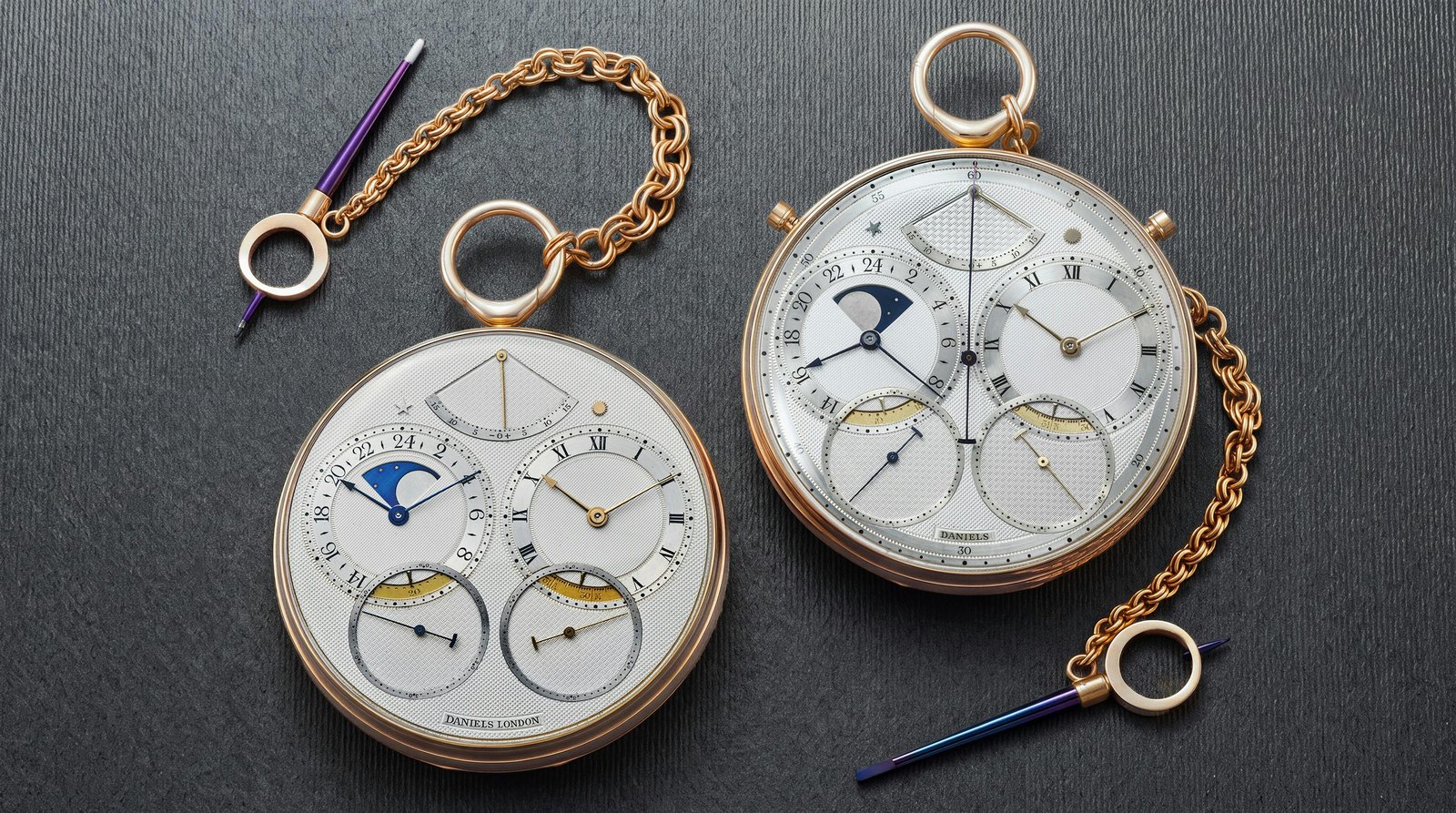
George Daniels was born in 1926 and grew up poor in London, and he went on to become the man most watchmakers point to when they explain why they started. He made nearly every part of his watches himself, invented the co-axial escapement that Omega now uses in millions of watches, and on his own made only 24 pocket watches and two wristwatches before the Millennium and Anniversary series he made with Roger W. Smith.
For his centenary, Phillips and The Hour Glass are gathering 22 of his watches in one place. The exhibition, George Daniels 100, opens alongside IAMWATCH in Singapore and runs from Friday, November 13 to Sunday, November 15, from 11 a.m. to 8 p.m. at the Singapore Edition Hotel. For the first time, it will reunite the Space Traveller and the Space Traveller II, both made in 1982. Daniels sold the first quickly to a collector, regretted it, and made the second for himself. He kept it until he died in 2011.
After Singapore, the exhibition moves to London in 2027.
Most of today’s independent watchmaking scene exists because one stubborn man proved a single person could still make a whole watch by hand. Seeing nearly all of his work in one room is about as close as horology gets to a pilgrimage, and it may not happen again for a very long time.
Raffles & sign-ups
MB&F M.A.D.2 Live
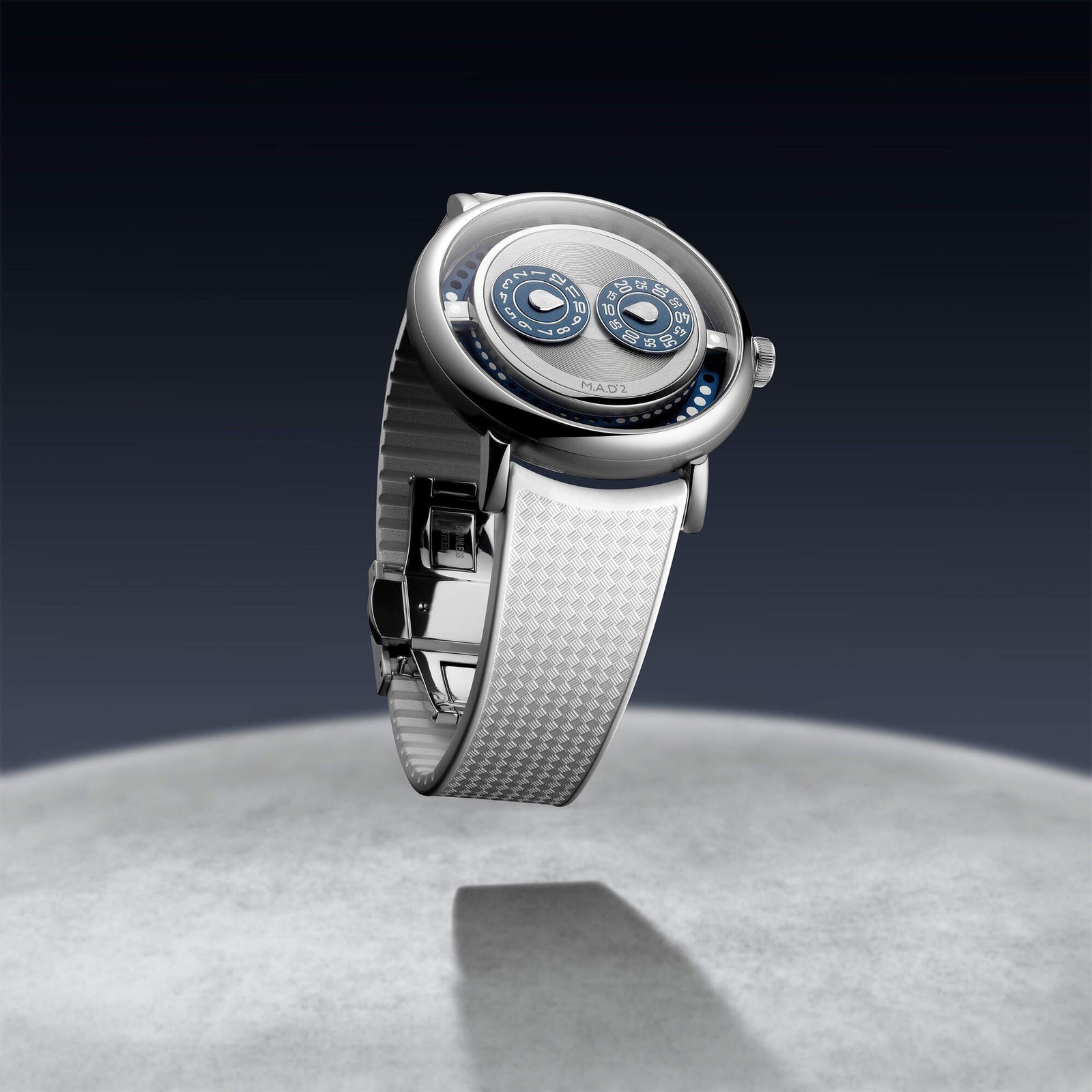
MB&F’s M.A.D.Editions exist for people who love the brand’s ideas but don’t have a Horological Machine budget. They’re sold through raffles because demand always beats supply, and the latest one comes with a twist: you have to show up in person.
The M.A.D.2 Live is a new event-only edition of the M.A.D.2, with a silver dial plate, electric blue hour and minute discs, a blue winding rotor and a white rubber strap. The deployant clasp is engraved with the code of the city where it was won. MB&F is taking it to 13 cities this year and next, and at each stop visitors to the M.A.D.Editions booth scan a QR code to enter a mini-raffle, with the draw a few days after the show. October brought stops in Milan from October 2 to 4, Paris on October 9 and 10, and New York from October 16 to 18.
There are three more chances this year: Geneva on November 6 and 7 at the M.A.D.Gallery, Hong Kong on November 19 and Taipei on November 20 and 21. Riyadh, Singapore and Dubai follow in early 2027. The watch costs about $3,500.
It’s a smart way to sell a watch. It rewards the people who make the effort, and gives every owner a story that starts with the city engraved on the clasp.
Business & partnerships
Zenith plans a smaller, higher future
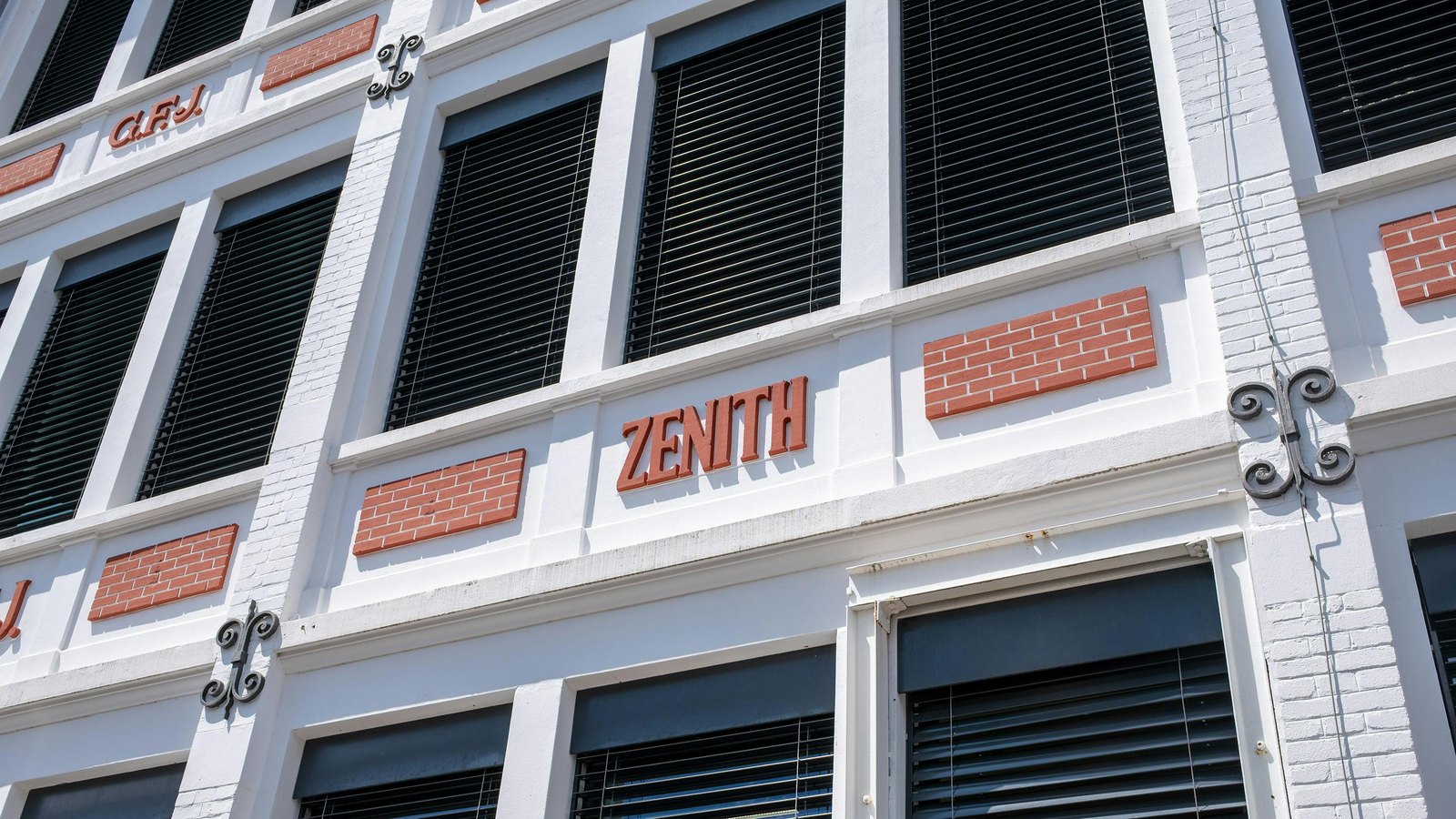
Zenith was founded in Le Locle in 1865 by Georges Favre-Jacot, and it’s best known for the El Primero, the high-beat automatic chronograph movement of 1969. For decades it has lived in the middle of the Swiss market, with most watches selling for about $10,000 to $18,000. This autumn its chief executive, Benoit de Clerck, told staff that the middle no longer works.
The LVMH-owned brand has opened a consultation on a restructuring that could cut about 100 of the roughly 200 jobs at the manufacture, and about 100 more in its international distribution and boutique network. The plan is to reposition Zenith as a low-volume, high-end watchmaker by 2029, with prices nearer about $60,000, the territory of its award-winning G.F.J. Calibre 135, and lines such as the Chronomaster, Defy and Pilot reportedly expected to wind down. The company has cited the strong franc, US tariffs and weaker demand in markets such as the Middle East and Asia. Zenith will keep supplying movements to other LVMH brands. The union has until November 12 to propose alternatives, and management must reply by November 16.
It follows staff cuts at several other Swiss brands, including Montblanc, which made its own announcement in Le Locle only days earlier.
A great name is choosing to get smaller to survive, and a lot of skilled people in a small mountain town will pay for it. The El Primero deserved a better market than this.
François-Henry Bennahmias advises Hublot

François-Henry Bennahmias ran Audemars Piguet for more than a decade and grew its annual sales past $2 billion, turning the Royal Oak into one of the most wanted watches on earth. Since leaving in 2024 he has founded The Honourable Merchants Group, and promised a watch brand of its own, N3W5, for Dubai Watch Week in 2027.
In October he turned up somewhere nobody predicted: Hublot. LVMH confirmed that he’s working with the brand as a consultant on a temporary, project-specific basis, offering strategic advice, while Julien Tornare stays on as chief executive. It comes during a busy stretch for the group’s watchmakers. Jean Arnault, who already oversees LVMH Watches along with the Gérald Genta and Daniel Roth brands, has recently taken charge of Hublot and Zenith too, and Zenith has just announced a deep restructuring.
Hublot is a brand Bennahmias understands better than most. Both he and the brand grew up in the same era of big cases, bold materials and celebrity friends, and Hublot has spent the past year reworking its collections and looking to its own past for direction.
A consultant isn’t a chief executive, and the arrangement is meant to be short. But when a group with LVMH’s resources calls the man who made AP the hottest brand in the business, it’s worth paying attention to what changes next.
Audemars Piguet launches The Watch Keepers
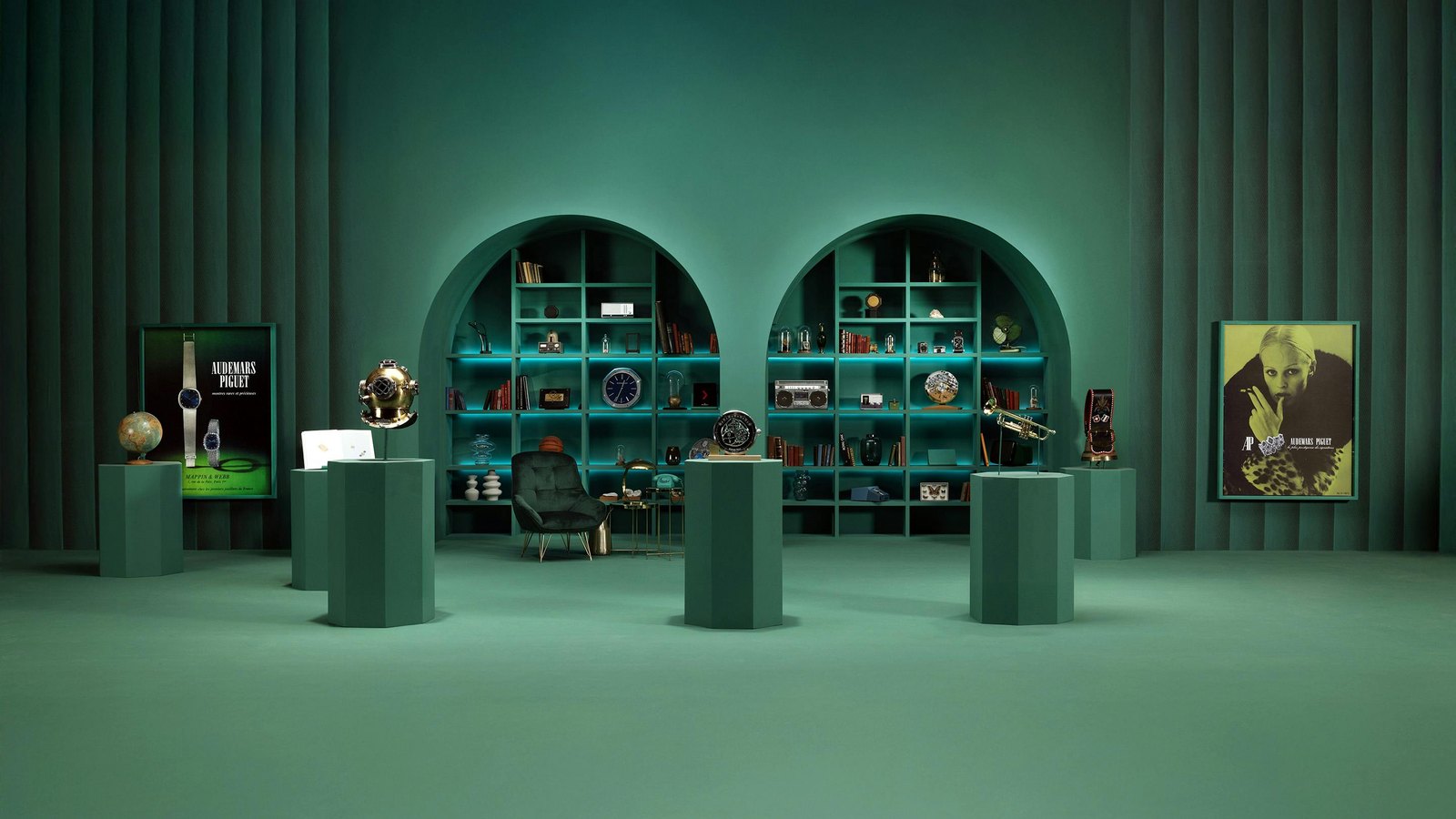
For most of its history, Audemars Piguet’s relationship with a watch ended when it left the boutique. What happened next, on the grey market and at auction, belonged to someone else. Since 2022 Rolex has run a certified pre-owned programme through its dealers, and it has become big business. In October, AP launched its own.
The Watch Keepers is a digital marketplace for AP watches at least two years old. Sellers send their watches to the brand, which checks them against its archives, certifies them, photographs them and lists them, either at a set price or through bidding. AP keeps the watch until it sells and handles delivery, though the seller remains the owner until then. Buyers get a two-year guarantee. For now, buying and selling is open in Switzerland and the European Union, with other markets, including the US, expected later. The programme is led by Marc Montagne, who joined from Vacheron Constantin and Jaeger-LeCoultre.
The timing is no accident. The pre-owned market is growing faster than the market for new luxury watches, and Rolex’s dealers sold a record $229 million of certified pre-owned watches in the third quarter alone.
For collectors, a brand guarantee on a second-hand Royal Oak is genuinely good news. For AP, it’s a way back into a conversation it used to leave to others, and in a market built on trust, the brand’s word may be the most valuable thing it sells.